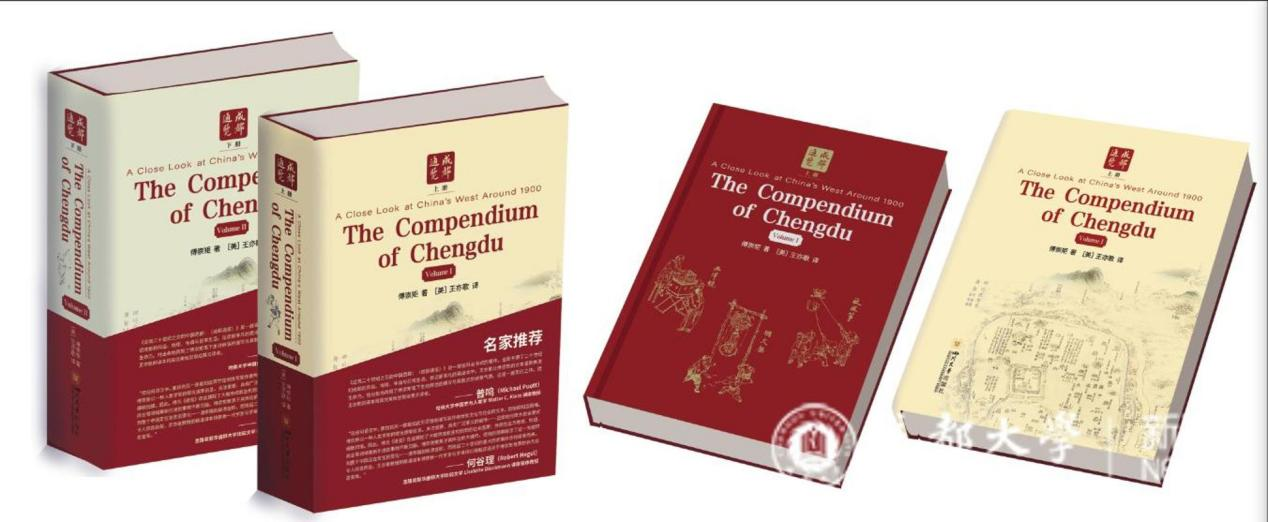
Recently, the full English translation of The Compendium of Chengdu—as an outcome of a project organized and implemented by the Research Center for Civilizations Mutual Learning and the "Belt and Road" at Chengdu University and supported by the Overseas Education College of Chengdu University—was officially published by Sichuan University Press and released globally.
With a total of about 2.4 million words, this translation consists of two volumes. It took five years to complete this work, which is the first complete English translation of The Compendium of Chengdu since the publication of the original work over a century ago, and also one of the important achievements in the international dissemination of Bashu cultural classics in recent years.
A "City Encyclopedia" for Understanding Late Qing Chengdu
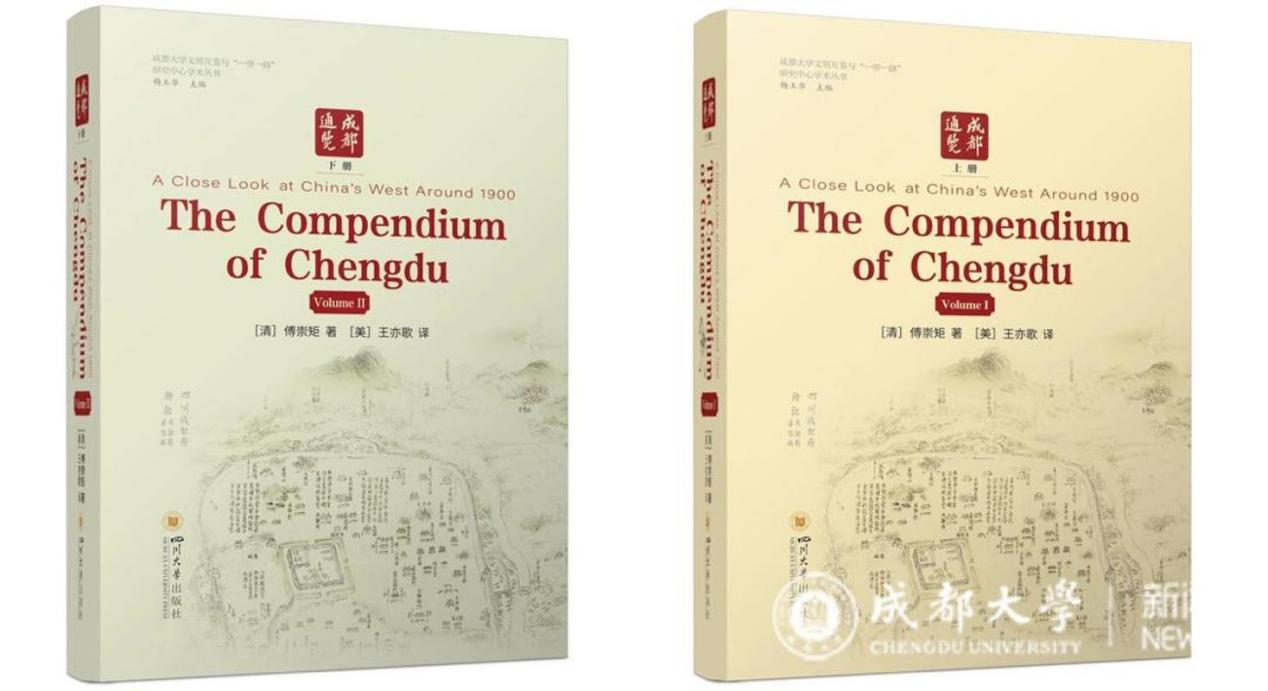
The Compendium of Chengdu was compiled by Fu Chongju, a scholar from Jianyang, around 1909. With nearly 700,000 Chinese characters and divided into more than 180 categories, it is regarded by academia as one of the most representative panoramic records of a city in modern China.
The book systematically records the social structure and urban operation of Chengdu in the late Qing Dynasty, covering everything from streets, city walls, government institutions, commerce and industry to local dialects, food culture, folk beliefs, and the bustling marketplace. Its content is all-encompassing, presenting an authentic portrait of the urban landscape and everyday life of late Qing Chengdu .
Compared with traditional local chronicles, The Compendium of Chengdu not only has rich value as local literature, but also preserves an important historical snapshot of Chinese society's transition from tradition to modernity. The book not only records social problems and limitations of the times, but also demonstrates the self-renewal capacity of the local society in the process of transformation, including the rise of new-style education, the development of public health concepts, the operation of charitable organizations, and the maintenance of industry order.
Therefore, The Compendium of Chengdu is not only a piece of local literature, but also an important text for observing the social transformation of modern Chinese cities.
Five Years of Continuous Progress: A Systematic Collation Project Transcending Language and Cultural Barriers
The translation work was led by Professor Yige Wang, a distinguished foreign expert at Chengdu University and a distinguished research fellow at the university's Overseas Education College.
Since the original work combines late Qing vernacular, semi-classical Chinese, and a large number of Bashu local vocabularies, and involves numerous industry systems, social organizations, price systems, and folk terminology, the translation work was not only a language conversion but also a complex project of cultural collation and cross-cultural interpretation.
During the translation process, continuous collation and unification were carried out regarding historical terms, local systems, folk industries, and social contexts, and a large number of annotations and cultural interpretations were made on Bashu dialects, folk expressions, and traditional trade names. All these efforts were to accurately convey the content of the original work while preserving Chengdu's unique urban temperament and cultural texture. Finally, after five years of continuous revision and refinement, the translation was officially published.
Promoting the Global Dissemination of Tianfu Culture: Forging a New Path for the International Expression of Local Culture
For a long time, international perceptions of Chengdu have mostly remained at the level of cultural symbols such as the giant panda and Sichuan cuisine, while systematic understanding of the city’s deeper historical and cultural traditions and accumulated urban civilization remains relatively limited.
The publication of the English translation of The Compendium of Chengdu provides an important text for overseas readers to gain an in-depth understanding of Chengdu's history and Chinese local society, while also offering new basic materials for international academic circles to study Chinese urban history, folklore history, and social cultural history.
At the same time, this project also has methodological significance in the translation of local cultural classics into foreign languages. The translation systematically sorts out issues such as the proper nouns of Bashu culture, local folk customs, dialect expressions, and traditional industry terms, exploring a practically valuable path for the international expression of Chinese local culture.
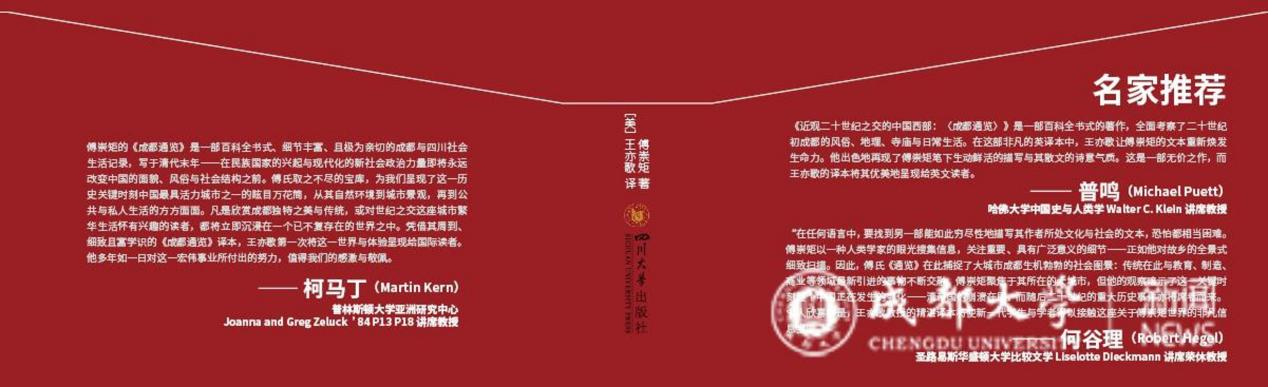
The international Sinological community has spoken highly of this project, and many international sinologists who participated in the review of the English translation have given positive comments on the project. Michael Puett, a sinologist from Harvard University, remarked that the book has “encyclopedic value”; Martin Kern, a sinologist from Princeton University, pointed out that The Compendium of Chengdu preserves “a vanished world” for future generations; Robert Hegel, a sinologist from Washington University in St. Louis, commented that the work not only presents the city of Chengdu, but also reflects the important transformation that the whole Chinese society was experiencing in the late Qing Dynasty.
In recent years, Chengdu University has been continuously promoting the international dissemination of excellent traditional Chinese culture and actively exploring new paths for the international expression of local culture and mutual learning among civilizations.
The publication of the English translation of The Compendium of Chengdu is a major achievement in the global dissemination of Bashu culture. Moreover, it reflects the university's continuous efforts in building international communication capacity, advancing cross-cultural research and fostering exchanges between civilizations.
In the future, the university will continue to leverage its platforms of international Chinese language education, regional cultural studies and international communication to promote more cultural achievements embodying the Chinese spirit and Bashu characteristics to the world, thereby enhancing the global reach and influence of Chinese civilization.
Editor: Min Xiuling Executive Editor: Lyu Jia